Sequence Control Course
Essential Knowledge
What Is PLC
What is a PLC? PLC stands for Programmable Logic Controller — an industrial device used to implement sequence control. It is the "brain of the equipment," writing a program (ladder diagram) inside the PLC to control external devices. Most people who study sequence control will ultimately work with a PLC.
Created: 2010
Updated: April 20, 2026
- What Is PLC?
- Difference Between PLC and Sequencer
- Appearance of a PLC
- Why Use a PLC?
- Learn with Videos
- Frequently Asked Questions (FAQ)
What Is PLC?
PLC stands for Programmable Logic Controller — one of the devices used to implement sequence control. A PLC works by writing a program (in this case, a ladder diagram) into it to control external equipment. In simple terms, it is the "brain that controls the equipment."
A PLC integrates the ability to receive input signals from sensors and switches, and to control output devices such as motors and solenoid valves. Power supply circuits and noise protection circuits are all packaged together, ready for immediate use in industrial settings.
Difference Between PLC and Sequencer
Mitsubishi-brand PLCs are commonly called "Sequencers." In this industry, both PLC and Sequencer are generally understood to mean the same thing. However, there is one important point to note: when asking an outside contractor to build equipment, always specify the PLC manufacturer. This is because "Sequencer" does not always imply Mitsubishi.
Historically, Mitsubishi held a large market share in PLCs, so in common usage "Sequencer = PLC" became widespread (because most PLCs were Mitsubishi). While "Sequencer" is actually a Mitsubishi brand name, there is a possibility the other party may be thinking of a different brand's PLC — so always confirm the manufacturer.
Appearance of a PLC
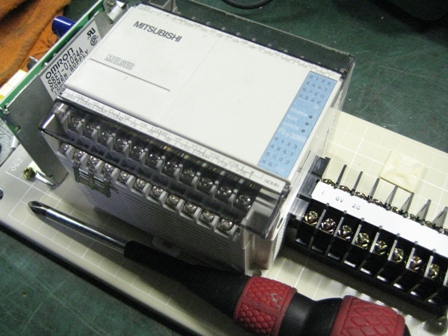
The appearance varies by manufacturer and comes in various types: a self-contained rectangular type, or a base unit type where you add the modules you need. Basically, you supply AC 100V power and connect sensors to the input/output terminal blocks. Here is a photo of the FX Series — a compact PLC model.
Why Use a PLC?
A PLC is a device that makes it easy to control external equipment on a computer using a language called Ladder Diagram — replacing the control previously done with relay circuits. Relay circuit wiring is extremely labor-intensive, but a PLC can be edited almost entirely on a computer, making it much simpler. It also makes it easy to implement control that was impossible with relay circuits alone.
For example, when operating a microcontroller, you need to incorporate circuits for power supply and noise elimination. A PLC is essentially a fully packaged set of all such circuits. Programs can be rewritten even during operation, and partial changes are also possible.
Recent PLCs are also highly functional, supporting optional units such as communication modules and analog output modules.
In terms of cost, PLCs are considerably more expensive than standalone microcontrollers. Their primary application is in dedicated machines — equipment of which only a few units are needed in the world — meaning industrial production and testing equipment. This is because PLCs, unlike microcontrollers, offer easy debugging and the flexibility to adapt to specification changes in production models.
Conversely, PLCs are generally too expensive for mass-produced products. Mass-produced items such as home appliances do not require debugging of programs. For those applications, microcontrollers are used to reduce cost and achieve miniaturization.
Now let's get into sequence control. Everything covered so far is just background — think of it as "there is something like this." If you are just starting to learn sequence control, please study carefully from the next section onward.
Welcome to the world of sequence control. Let's begin. It may seem difficult at first, but don't give up — keep going.
Frequently Asked Questions (FAQ)
The "Illustrated Introduction: Understanding the Latest Sequence Control and Circuit Diagrams" is available as a Kindle (eBook) edition. If you prefer the paperback version, please select "Paperback" in the format options, or purchase from the top page.